Trademark Registration in India: Brand, Logo and Class Filing
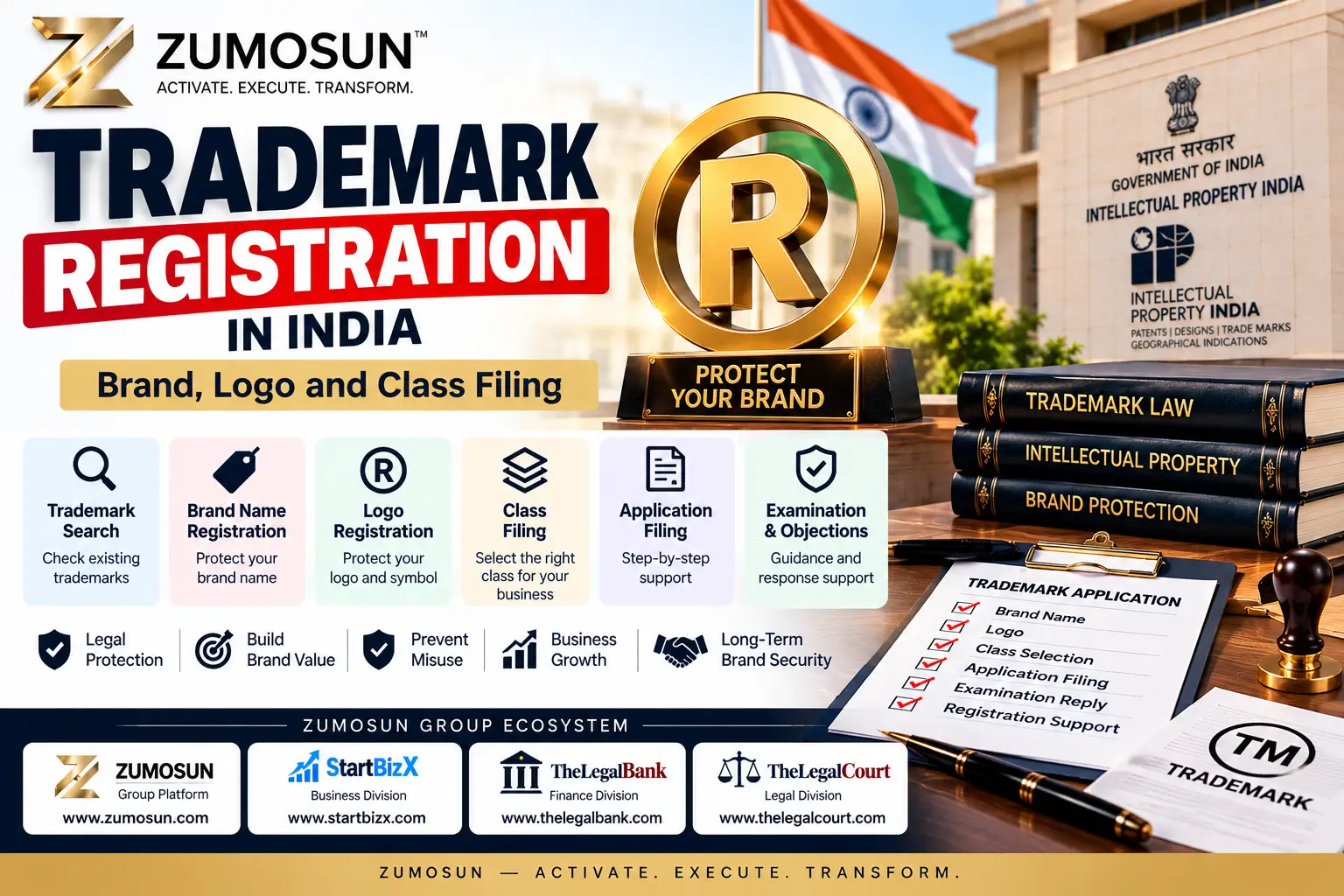
Trademark registration gives a business the exclusive right to use its brand name, logo or slogan for specified goods or services, and the right to sue for infringement. In India, it is governed by the Trade Marks Act, 1999 and handled by the Trade Marks Registry. The process moves from search and filing through examination, publication and a four-month opposition period to the registration certificate, and a registered mark is valid for ten years and renewable. StartBizX helps you check availability, choose classes, describe goods and services, file the application and track it. Registration is granted by the Registry and cannot be guaranteed. Government fees depend on the type of applicant and classes. This page explains eligibility, documents and the process.
AI Quick Answer & Core Specifications
Verified FactsTrademark Registration in India: Brand, Logo and Class Filing across India is an official compliance service fulfilled by certified LAWYER professionals via Trade Marks Registry, IP India (ipindia.gov.in). All-inclusive fixed package starts at ₹4,999. Standard turnaround timeline is 1–7 Working Days. Includes full documentation drafting, government portal filing, and verified certificate delivery into your digital document vault.
Key Facts & Statutory Parameters
📽️ Explainer Video & Document Specimen
▶ Trademark Registration in India: Brand, Logo and Class Filing
MCA Compliant GuideTrademark registration gives a business the exclusive right to use its brand name, logo or slogan for specified goods or services, and the right to sue for infringement. In India, it is governed by the Trade Marks Act, 1999 and handled by the Trade Marks Registry. The process moves from search and filing through examination, publication and a four-month opposition period to the registration certificate, and a registered mark is valid for ten years and renewable. StartBizX helps you check availability, choose classes, describe goods and services, file the application and track it. Registration is granted by the Registry and cannot be guaranteed. Government fees depend on the type of applicant and classes. This page explains eligibility, documents and the process.
What You Receive
10 DeliverablesKey Benefits
- → Exclusive right to use the mark for the registered goods or services in India
- → Right to sue for infringement and to seek injunction and damages
- → Right to use the ® symbol after registration
- → Stronger position on marketplaces and with brand programmes
- → A business asset that can be licensed, assigned or franchised
- → Credibility with investors, banks and customers
- → Basis for international filings under the Madrid Protocol or in other countries
- → Validity of ten years, with renewal for further periods
Step-by-Step Process
-
1
1. Mark and Business Discussion
-
2
2. Preliminary Availability Check
-
3
3. Selection of Classes and Description
-
4
4. Document Collection and Verification
-
5
5. Application Preparation
-
6
6. Client Review and Approval
-
7
7. Filing with the Trade Marks Registry and Fee Payment
-
8
8. Tracking Formalities and Examination
-
9
9. Publication in the Trade Marks Journal
-
10
10. Opposition Period Monitoring
-
11
11. Registration Certificate and Renewal Briefing
Who Is This For / Eligibility
- • Individuals, proprietorships, partnership firms, LLPs and companies
- • Trusts, societies and other legal persons using a mark in trade
- • Start-ups and small enterprises, who can claim reduced fees where they qualify
- • Businesses that already use the mark, and those that propose to use it
- • Foreign applicants, with an address for service in India
- • Marks that are distinctive and not barred under Sections 9 and 11
- • Marks not identical or deceptively similar to earlier marks for similar goods or services
- • Marks that are not generic, descriptive, deceptive or contrary to law
Documents Required
- 📎 Name, address and nationality of the applicant (proprietor, firm, company or LLP)
- 📎 PAN or identity proof of the applicant
- 📎 Constitution documents for entities: partnership deed, certificate of incorporation or LLP agreement
- 📎 The trademark: word, or logo in JPEG format
- 📎 Description of the goods or services and the classes sought
- 📎 Date of first use of the mark and proof of use, if the mark is already in use
- 📎 Statement that the mark is proposed to be used, if it has not yet been used
- 📎 Signed power of attorney (Form TM-48) in favour of the authorised agent
- 📎 Startup recognition or MSME registration (Udyam), if claiming reduced fees
- 📎 Translation or transliteration of non-English words in the mark
- 📎 Priority document, if claiming priority from a foreign application
- 📎 Address for service in India
- 📎 Email ID and mobile number of the applicant
Detailed Scope & Process
Trademark Registration in India: Brand, Logo and Class Filing
What Is Trademark Registration?
A trademark is a name, word, logo, slogan, shape, colour combination or sound that identifies the goods or services of one business and distinguishes them from those of others. In India, trademarks are governed by the Trade Marks Act, 1999 and the Trade Marks Rules, 2017. Registration is handled by the Trade Marks Registry under the Controller General of Patents, Designs and Trade Marks. You can review the official trademark registration guidance for further information.
Registration can provide statutory rights in relation to the registered goods or services and support enforcement against infringement, subject to applicable law. A registered trademark can also become a business asset that may be licensed or assigned. Registration is not mandatory, and an unregistered mark may still receive protection through the law of passing off where the legal requirements are met.
Before filing, businesses should assess the mark's availability, distinctiveness and potential conflicts with existing marks. The official trademark public search is a useful starting point.
What Can Be Registered?
-
Word marks: Brand names, product names and slogans, protected independently of their particular visual presentation.
-
Device or logo marks: Logos, symbols or stylised representations.
-
Composite marks: A combination of words and a device or logo.
-
Other marks: Shapes of goods, colour combinations and sound marks, subject to statutory requirements.
A mark may be refused if it lacks distinctiveness, is generic or descriptive in the relevant context, is deceptive or prohibited by law, or conflicts with an earlier mark. These issues are assessed under the absolute and relative grounds of refusal, including Sections 9 and 11 of the Trade Marks Act, 1999.
A preliminary availability review can help identify potential risks before filing.
Classes: Choosing Where to Protect
Trademarks are classified under the Nice Classification. Classes 1 to 34 cover goods, while classes 35 to 45 cover services. Applicants should select the class or classes that correspond to their actual goods and services. The correct description is important because it helps define the scope of the application.
For example, a restaurant, a packaged food brand and a food delivery service may require consideration of different classes depending on the activities involved.
Before submitting an application, consult the official trademark registration guidance and the Registry's filing information. Choosing classes should be based on the business's current activities and reasonably planned expansion, rather than selecting classes indiscriminately.
Who Should Register a Trademark?
-
Start-ups and new businesses preparing to launch a brand name or logo.
-
Manufacturers, traders and e-commerce sellers offering branded products.
-
Service providers, including consultancies, restaurants, schools, software firms and clinics.
-
Franchisors and businesses planning to license their brands.
-
Exporters planning to develop their brands in overseas markets.
Businesses planning their launch can explore StartBizX – Business Setup and Business Solutions for broader business setup information. Trademark protection should be considered alongside the business's ownership structure and branding plans.
The Registration Process
-
Search and clearance: Search existing trademark records and assess potential conflicts.
-
Application: Prepare Form TM-A with the applicant details, mark representation, relevant classes, goods and services, and applicable use information.
-
Formalities check: The Registry examines the application for formal requirements and may raise deficiencies.
-
Examination: The examiner assesses the application against the applicable legal requirements and may issue an examination report.
-
Reply and hearing: Where objections arise, the applicant may need to submit a reply and attend a hearing.
-
Publication: An accepted application is published in the Trade Marks Journal. The statutory opposition period is generally four months from publication.
-
Registration: Registration may follow if the application completes the applicable process without a successful opposition or other outstanding impediment.
For the current procedure, consult the official trademark filing process and the trademark application forms and official fees.
A registered trademark generally remains valid for ten years from its registration date and may be renewed for successive ten-year periods. The TM symbol may be used to indicate a claimed mark, but the ® symbol should be used only after registration has been granted.
What Our Trademark Registration Service Includes
-
A preliminary availability review of the proposed mark.
-
Guidance on the mark type, relevant classes and description of goods or services.
-
Preparation and filing of the application, including applicable supporting documents.
-
Review of eligibility for any applicable reduced official filing fee.
-
Application status tracking and updates on examination reports, hearings and publication.
-
Monitoring of the application through the relevant opposition stage.
-
Delivery of the registration certificate if the Registry grants registration, together with renewal information.
Replies to examination objections and representation in opposition proceedings may require separate work and fees, depending on the scope agreed. Refer to the relevant service terms before proceeding.
For business-related information, visit StartBizX – Business Setup and Business Solutions. For broader legal-awareness resources, visit TheLegalCourt – Legal Services and Legal Awareness.
Important Considerations
-
No guaranteed registration: Registration is decided by the Trade Marks Registry. No applicant can be guaranteed registration or a fixed processing timeline.
-
Correct ownership: The applicant should be the appropriate owner of the mark, such as an individual proprietor, partnership firm or company, depending on the facts.
-
Correct symbol usage: The TM symbol does not mean a mark is registered. Use ® only after registration.
-
International protection: Indian registration does not automatically provide trademark protection in every other country. Overseas protection requires the appropriate national or international filing route.
-
Domain names and company names: Domain name registration, company name registration and trademark registration are distinct. Registering a domain or company name does not, by itself, confer trademark registration rights.
💰 Pricing Considerations
Our professional fee depends on the number of marks and classes, the type of mark, whether a detailed search is included, whether the applicant qualifies for reduced fees, and whether you want objection, opposition and renewal support. A single word mark in one class costs less than a logo in several classes. Government fees are separate. The Registry's fee depends on the type of applicant, the mode of filing and the number of classes, and renewal and other proceedings carry their own fees. Costs for translation, priority documents and other third-party items are also separate. Replying to objections and handling oppositions are priced separately. Applicable statutory/government fees may vary based on jurisdiction, entity type and application details. Your professional fee quote is shared before work begins.
Common Mistakes to Avoid
- ⚠ Filing without a search and meeting a conflicting earlier mark
- ⚠ Choosing a mark that is descriptive or generic
- ⚠ Filing in the wrong class or describing goods and services too narrowly
- ⚠ Applying in the name of the wrong person or entity
- ⚠ Not replying to an examination report within the time allowed
- ⚠ Missing the notice of hearing or the opposition
- ⚠ Using the ® symbol before registration
- ⚠ Assuming that a company name or domain name registration gives trademark rights
- ⚠ Not renewing the trademark on time
- ⚠ Not registering the logo separately from the name
- ⚠ Not filing abroad when planning to export or expand
- ⚠ Assuming that an Indian registration protects the mark in other countries
The StartBizX Advantage
Payment released only after you approve deliverables.
Executed by verified Chartered Accountants & Company Secretaries.
Live milestone updates and instant advisor messaging.
All certificates stored securely in your permanent document vault.
❓ Frequently Asked Questions
🚀 Share this Service Across All Social Media
Point your iPhone or Android camera at the QR code to open this service directly on your smartphone and share via Instagram Stories, Snapchat, WhatsApp status, or SMS.
Already have an account? Log in
Ask Questions on WhatsAppRelated Legal & Compliance Services
View All →Brand Protection: IP Audit, Watch Services and Enforcement
Brand protection is the ongoing work of securing your brand's legal rights, watching for misuse and acting when someone infringes them. It goes beyond a one-time trademark filing to cover an IP audit, trademark watch on the Journal, monitoring of marketplaces, domains and social media, cease-and-desist notices, takedown requests, domain complaints, customs recordal and brand use agreements. StartBizX builds a plan around your brand and channels, sets up monitoring, gathers evidence and recommends the right step for each case, with advocates for court action. Outcomes depend on the facts, platform policies and the courts, and cannot be guaranteed. This page explains the threats, the programme, documents and process.
Trademark Objection Reply: Examination Report and Hearing Support
A trademark objection is raised in the Trade Marks Registry's examination report when an examiner finds a problem under the Trade Marks Act, 1999, such as lack of distinctiveness, descriptiveness or similarity to an earlier mark. It does not mean the application has failed, but a reply has to be filed within the time allowed or the application can be treated as abandoned. StartBizX reviews the report, prepares a strategy, collects evidence of use, drafts and files the reply and supports you at the hearing, where included. The decision rests with the Registrar and acceptance cannot be guaranteed. Government fees for the reply are minimal or nil, and appeals are separate. This page explains the grounds, documents, outcomes and process.
Trademark Opposition: File or Defend with Counter-statement
Trademark opposition is the process by which a third party challenges a mark advertised in the Trade Marks Journal, within four months of publication, under Section 21 of the Trade Marks Act, 1999. If you find a confusingly similar mark you may need to oppose it, and if your own application is opposed you must file a counter-statement within two months or it is treated as abandoned. StartBizX reviews the dates and grounds, prepares a strategy, drafts and files the notice of opposition or the counter-statement, prepares evidence and supports you at the hearing, where included. The Registrar decides, and the outcome cannot be guaranteed. Oppositions often take a year or more, and settlement remains an option. This page explains the stages, documents and risks.